How can you tell what ingredients we use? How do you know which of our takeaway dishes are vegan? What steps do we take to ensure we can guarantee you high-quality, hygienically impeccable food? You’ll find all this information on this page.
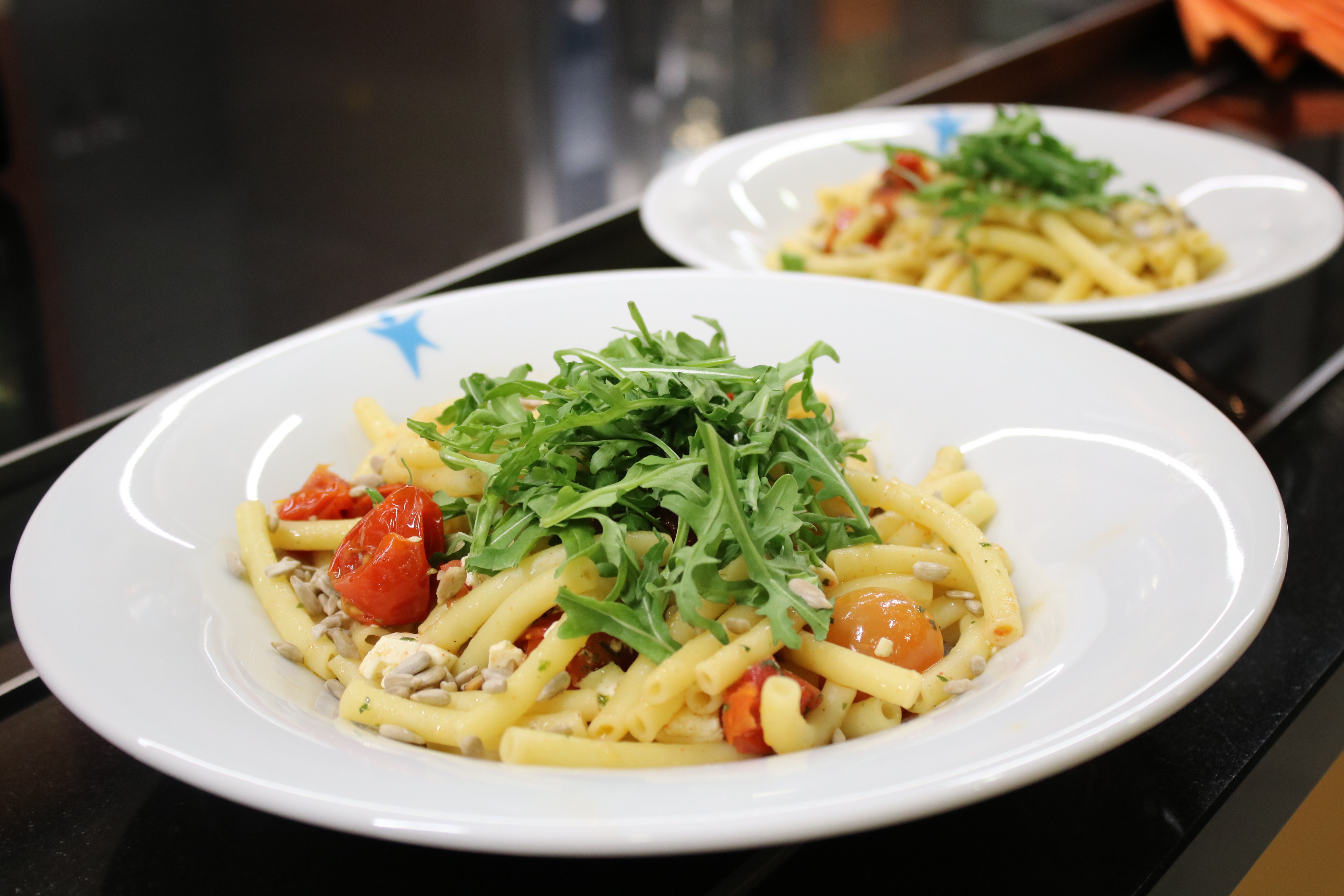
In our canteens and cafeterias, we mainly use fresh ingredients and take great care to ensure that, where we have to use pre-packaged products, they contain as few additives as possible – ideally none at all.
In addition to additives subject to labelling requirements and allergenic ingredients, we also voluntarily provide further information to give you the best possible overview of your dietary habits or in relation to any important personal restrictions you may have.
You can find the full overview here: ‘Labelling Overview: Canteens & Cafeterias’
The numbers and images shown there can also be found in our menus, on display cases, noticeboards, stands, etc. Furthermore, if you are unsure or have any queries, our staff at the facilities will be happy to offer advice and assistance at any time.
Important note:
The labelling and preparation of the food and drink on offer in our facilities are always carried out with the utmost care. The information regarding ingredients is based on the details we receive from manufacturers and suppliers. Due to the wide variety of products, cross-contamination may occur and products may contain traces of ingredients not listed.
Cross-contamination cannot be completely ruled out even in our own production processes. We cannot therefore exclude the possibility that the food and drinks on offer may contain other ingredients subject to labelling requirements, or traces thereof, in addition to those already labelled.
In particular, guests who could suffer serious health problems as a result of allergenic ingredients should, if in doubt, check with the relevant kitchen or cafeteria manager before consuming our food and drink. We thank you for your understanding!
All guests have the opportunity to provide feedback and comments – including on any critical aspects of our services and offerings – either via the feedback forms available on the premises or via the general email address ganz.ehrlich@swcz.de. These are evaluated, analysed and responded to, and, where necessary, acted upon to implement improvements.
Food safety is governed by a wide range of regulations and laws that are binding on all businesses in the food industry. The most important regulations include:
Regulation (EC) No 178/2002 laying down the general principles and requirements of food law
. This Regulation sets out the fundamental safety requirements that must be observed throughout the entire food production process.
Food Hygiene Regulation (LMHV)
This sets out the hygiene requirements that must be met in all areas of food processing and storage.
Regulation (EU) No 1169/2011 on the provision of food
information to consumers. This regulation ensures that you, as a consumer, know exactly what is contained in food – from ingredients and allergens to additives.
These legal provisions serve not only to protect your health, but also to safeguard the quality of the food offered to you in our establishments.
Responsibility for food safety lies with us. To ensure that all legal requirements are met, we are obliged to carry out our own checks in our university catering facilities. These include:
an internal HACCP (Hazard Analysis and Critical Control Points)
scheme – a globally recognised system that identifies all potential hazards in food production and establishes control points to detect and subsequently minimise these hazards.
Regular hygiene checks
: We continuously monitor cleanliness and compliance with hygiene standards in all areas of our canteens and cafeterias, including goods reception, storage, production/processing and sales. In addition to product hygiene, staff hygiene also plays a crucial role. We carry out spot checks to ensure compliance, for example by taking swab samples from our employees’ hands.
Documentation and traceability
All checks and measures carried out are documented so that, in the event of a complaint, rapid traceability is possible.
In addition to our in-house quality control procedures, we work in close collaboration with an independent laboratory. This laboratory carries out microbiological tests once a year at each of our university catering facilities. These external tests are an important part of food safety and include:
Food samples
: As part of the microbiological tests carried out, compliance with the guideline and warning values set by the German Society for Hygiene and Microbiology (DGHM) is checked for various parameters across a wide range of foodstuffs.
Dishwasher
samples: Both the so-called ‘rinse water’ in the machine and the cleaned dishes are subjected to microbiological testing.
Drinking water samples
: Microbiological tests are carried out to ensure compliance with the requirements of the Drinking Water Ordinance.
In addition, we are subject to unannounced inspections by the Food Safety and Veterinary Office of the City of Chemnitz or the District of Zwickau, which audits our canteens and cafeterias with a holistic focus on food safety.
Hygiene is paramount in food production and processing. To ensure the safety of our products, it is essential that all areas involved in production, storage and sales are regularly cleaned and disinfected. This includes:
Cleaning and disinfection plans for staff, product and environmental hygiene
We have drawn up detailed plans for daily cleaning and disinfection to prevent food from becoming contaminated with pathogenic germs, harmful substances or similar.
Use of approved cleaning products
We use only cleaning and disinfectant products that are approved for use in the food sector and leave no residues that could compromise food safety.
In the event of complaints or product recalls, it is important that we are able to verify the condition and quality of the food we supply at any time – even after the fact. For this reason, we take retention samples every day, which are stored under secure conditions (deep-frozen). These samples are important because:
they can
still be examined for a defined period after sale; in the event of quality issues or suspected contamination, these retention samples can be tested and analysed quickly.
a statutory retention period must
be observed. Retention samples must be kept for a specific period to allow for any necessary tests to be carried out if required.
Thanks to these retention samples, a rapid and precise analysis can also be carried out by a microbiological laboratory should the need arise.
Our teams receive appropriate training in line with our legal obligations and whenever there are any changes or adjustments to our hygiene-related operational procedures. These training sessions also address any shortcomings or deficiencies that may have been identified – which can occur in isolated cases and have come to light during internal and external audits – thereby helping to prevent them in future.
We source around 85% of the food we purchase through tenders organised by a joint procurement scheme run by the East German student services organisations (excluding Berlin). This enables us to exert a relatively significant influence on the quality of the foodstuffs procured, without facing major economic and/or organisational challenges.
Incoming goods are also assessed against a set of pre-defined criteria for rejection; in the event of non-compliance, this is documented and reported, and substandard goods are largely avoided or excluded altogether.
Furthermore, the quality criteria jointly defined in the tenders help to better tap into sources of organic produce from organic farms in Saxony and neighbouring federal states, thereby enabling a targeted influence on the market and its development.
In the areas of warehousing, processing and production, our internal HACCP scheme helps us to clearly implement and monitor all hygiene requirements. This is complemented by cold store monitoring, ‘cook & chill’ and ‘cook & freeze’ methods in food preparation, and similar measures. All of this contributes to the safety of our offerings, so that you can feast and enjoy your meals in our canteens and cafeterias at any time with a clear conscience!
René Rothenburger
Head of the Hygiene and Nutrition Management Department
University catering
210
Catrin Herzig
Head of Food Procurement
University catering
213